
Mathematics is an important part of a child’s education, but many students find calculations challenging when they rely only on memorised formulas and traditional methods. Learning alternative calculation techniques can make mathematical practice more engaging and help students explore different ways to solve problems.
Vedic Mathematics is one such approach. It introduces techniques designed to simplify certain calculations and encourages students to look for patterns and alternative solution methods.
For parents exploring Vedic Mathematics classes in Qatar, understanding how this approach works can help them decide whether it is suitable for their child’s learning needs.

What Is Vedic Mathematics?
Vedic Mathematics is a system of mathematical techniques popularised by Indian scholar Bharati Krishna Tirthaji in the twentieth century. It is known for presenting alternative methods for performing arithmetic calculations, including multiplication, division, squaring, and other numerical operations.
Depending on the technique and the calculation involved, students may be able to solve certain problems using fewer written steps or mental calculation methods.
Unlike learning a single formula for every problem, Vedic Mathematics encourages students to explore different approaches and identify patterns in numbers.
It is best used as a complement to school mathematics, helping students strengthen their understanding of calculations alongside their regular curriculum.
Five Potential Benefits of Learning Vedic Mathematics
1. Develops Mental Calculation Skills
Vedic Mathematics introduces techniques that can help students perform certain arithmetic calculations mentally.
With guided instruction and regular practice, students can learn to recognise numerical patterns and choose suitable methods for solving problems.
These techniques can be particularly useful for practising arithmetic operations such as multiplication, division, and squaring.
2. Encourages Logical Thinking and Problem-Solving
Mathematics involves more than finding the correct answer. Students also need to understand relationships between numbers and determine which methods are appropriate for different problems.
Vedic Mathematics exposes learners to alternative calculation strategies. Comparing these methods with conventional approaches can encourage them to think critically and understand why particular solutions work.
3. Can Make Calculation Practice More Engaging
Repeated arithmetic exercises may become monotonous for some learners. Introducing new calculation techniques can provide a different way to approach familiar problems.
Students can practise selected techniques through progressively challenging exercises, puzzles, and timed activities where appropriate.
The aim should be to develop accuracy and understanding rather than simply completing calculations as quickly as possible.
4. Builds Confidence Through Practice
Some students feel uncomfortable when they encounter lengthy calculations or unfamiliar mathematical questions.
Learning a technique that makes a particular calculation easier can help students approach similar problems with greater confidence.
As students practise and understand the methods, they can gradually learn to select suitable strategies independently.
However, confidence develops differently for every learner, and regular encouragement is important.
5. Introduces Different Ways to Approach Mathematics
There is often more than one way to solve a mathematical problem. Exploring alternative methods helps students understand that calculations do not always need to follow one fixed procedure.
For example, a multiplication problem may sometimes be simplified by using numbers close to a convenient base, such as 10, 100, or 1,000.
Learning these approaches alongside conventional methods gives students additional strategies they can apply when appropriate.
Vedic Mathematics vs. Traditional Mathematics
Vedic Mathematics and conventional school mathematics serve complementary purposes. Understanding their differences can help parents see how both approaches may fit into a child’s learning journey.
| Aspect | Vedic Mathematics | Traditional Mathematics |
|---|---|---|
| Main approach | Alternative calculation techniques and numerical patterns | Standard mathematical methods and procedures |
| Mental arithmetic | Emphasises techniques for selected mental calculations | Develops mental and written calculation skills |
| Problem-solving | Explores alternative ways to approach certain calculations | Covers a broad range of mathematical concepts and methods |
| Written working | Some techniques may reduce the number of written steps | Written steps often help demonstrate the method and reasoning |
| Learning objective | Develop additional calculation strategies | Build comprehensive mathematical knowledge and understanding |
Neither approach needs to replace the other. Students should continue developing their understanding of mathematical concepts, written methods, and problem-solving skills through their regular education.
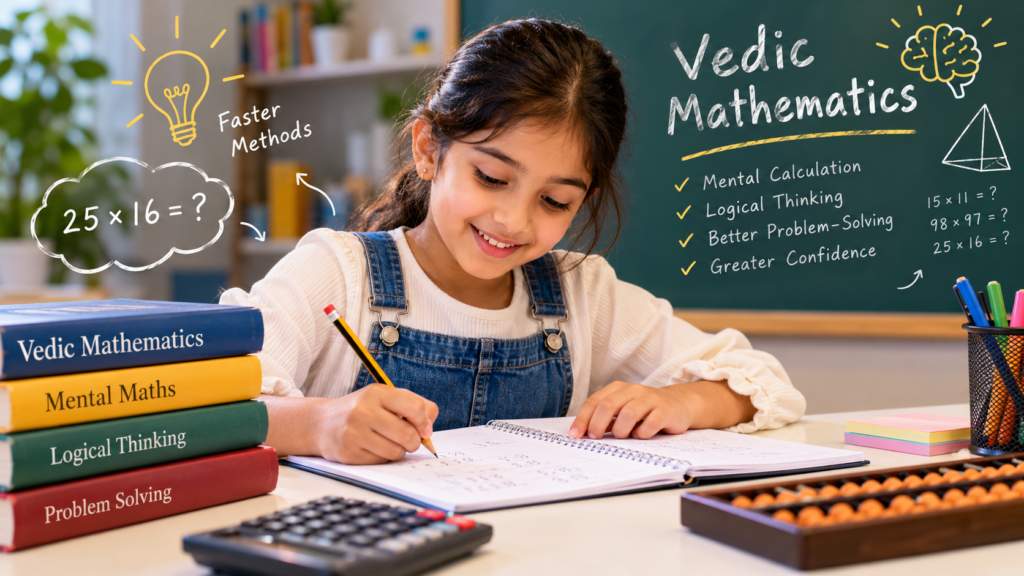
How Does Vedic Mathematics Work? An Example
One way to introduce Vedic Mathematics is through simple numerical patterns.
Consider the multiplication problem:
25 × 16 = ?
Using a conventional multiplication method:
25 × 16 = 25 × (10 + 6)
= 250 + 150
= 400
Another way to approach the same problem is to recognise that 25 is one-quarter of 100.
Therefore:
25 × 16 = 100 × (16 ÷ 4)
= 100 × 4
= 400
This example uses a numerical relationship to simplify the calculation. It illustrates the broader idea of exploring efficient strategies rather than relying on one method for every problem.
Vedic Mathematics includes specific techniques for different types of calculations, and students should learn when each technique is appropriate.
Is Vedic Mathematics Suitable for Every Student?
Vedic Mathematics may appeal to students who enjoy working with numbers, discovering patterns, and experimenting with different calculation methods.
It can also provide additional practice for learners who want to become more comfortable with arithmetic.
However, its suitability depends on the student’s age, existing mathematical knowledge, learning preferences, and the teaching approach used.
Parents should look for a programme that introduces concepts gradually, provides opportunities for practice, and encourages students to understand the reasoning behind each method.
Vedic Mathematics should support school learning rather than create pressure to calculate faster or memorise techniques without understanding them.
How Parents Can Support Mental Maths Practice at Home
Parents can help children develop their calculation skills through short, regular practice sessions.
Here are a few practical suggestions:
- Start with familiar numbers: Begin with calculations appropriate to your child’s current ability.
- Introduce patterns gradually: Use simple examples to help children recognise relationships between numbers.
- Encourage different methods: Ask your child whether they can solve a problem another way.
- Focus on accuracy first: Speed should come naturally with understanding and practice.
- Make learning enjoyable: Use number games, puzzles, and everyday situations involving money, counting, or quantities.
- Avoid unnecessary pressure: Encourage progress without comparing your child with other students.
Even a few minutes of enjoyable practice can provide an opportunity to reinforce mathematical concepts.
Explore Vedic Mathematics Classes in Qatar at SDC
Skills Development Centre (SDC) Qatar offers a range of educational and extracurricular programmes, including Vedic Mathematics.
For families interested in exploring alternative approaches to calculation and number patterns, a structured learning programme can provide an opportunity to practise these techniques with guidance.
Before enrolling, parents can enquire about the programme’s age requirements, syllabus, class schedule, teaching methods, and learning objectives to determine whether it meets their child’s needs.
Visit the Skills Development Centre Qatar website to explore its programmes and enquire about Vedic Mathematics classes.
Frequently Asked Questions
Vedic Mathematics is used to teach alternative techniques for performing selected arithmetic calculations. These methods can help learners explore number patterns and practise mental calculation.
It can provide additional strategies for solving certain arithmetic problems. The results depend on the student’s understanding, practice, and ability to apply the techniques correctly.
It may be suitable for school students who have an appropriate foundation in arithmetic. Parents should select a programme that matches the child’s age and current learning level.
No. It is best considered an additional approach to calculation. Students still need to develop a sound understanding of mathematical concepts, standard procedures, and problem-solving.
Parents can contact Skills Development Centre Qatar through its official website to enquire about course availability, age requirements, schedules, and fees.
Conclusion
Vedic Mathematics introduces students to alternative calculation techniques that can make selected arithmetic problems easier to approach. Through guided practice, learners can explore number patterns, develop additional problem-solving strategies, and become more familiar with mental calculations.
For parents considering Vedic Mathematics classes in Qatar, the key is to choose a programme that complements school mathematics and supports the child’s individual learning needs.
Explore the educational programmes available at Skills Development Centre Qatar to discover suitable learning opportunities for your child.