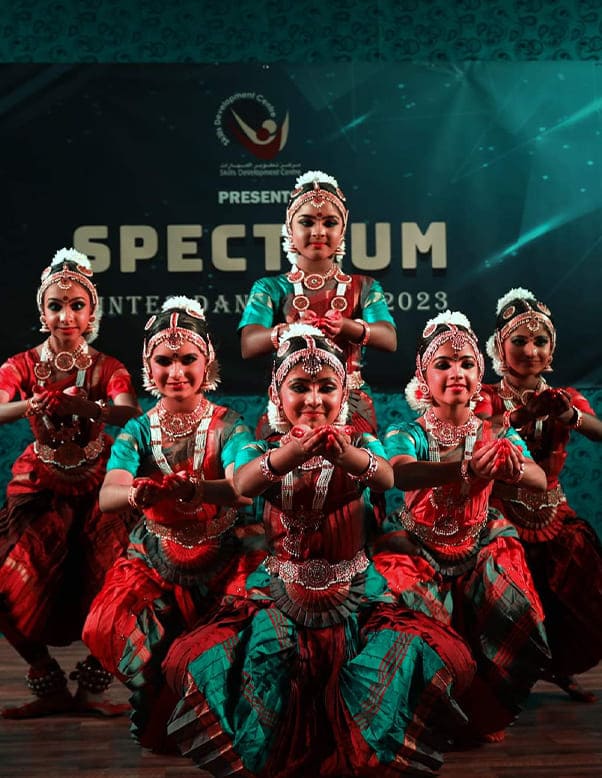
Bharatanatyam
The origins of Bharatanatyam, a classical Indian dance form, can be traced back to precursors dating as far back as the 2nd century CE, as documented in the ancient Tamil epic Silappatikaram. Temple sculptures from the 6th to 9th century CE further indicate that dance had evolved into a refined performance art by the mid-1st millennium CE. Originally known as Sadiraattam and later renamed Bharatanatyam in 1932, this dance tradition stands as the oldest classical dance form in India. It holds the esteemed position of being the state dance of Tamil Nadu.
Bharatanatyam encompasses various styles known as ‘banis.’ A ‘bani,’ which means ‘tradition,’ refers to the specific dance technique and style associated with a particular guru or school, often named after the guru’s village.
Mohiniyattam
Mohiniyattam, the classical solo dance form of Kerala, finds its inspiration in Hindu mythology, where it embodies the graceful art of Mohini, the celestial enchantress. The origins of Mohiniyattam are deeply rooted in Hindu mythology, with a legend recounting the divine episode when the ocean of milk was churned in pursuit of the elixir of life and immortality. In this tale, the demons absconded with the precious elixir, causing distress among the gods. Lord Vishnu, in a remarkable turn of events, assumed the alluring form of the celestial seductress Mohini. Through her captivating charm, Vishnu entranced the demons, successfully retrieving the elixir and returning it to the gods.
Kuchipudi
Kuchipudi, one of India’s foremost classical dance forms, holds a prestigious position among the ten prominent classical dances of the country. This captivating dance-drama performance art originated in a village within the Krishna district of Andhra Pradesh, India. Like many other revered Indian classical dance forms, Kuchipudi traces its roots to the ancient Hindu Sanskrit text ‘Natya Shastra’ and has deep associations with temples, spiritual beliefs, and wandering minstrels.
This ancient art form is documented in 10th-century copper inscriptions and 15th-century texts such as ‘Machupalli Kaifat.’ Tradition holds that it was systematized and refined in its present form during the 17th century by the Advaita Vedanta sect’s sanyasin, Tirtha Narayana Yati, and his disciple Siddhendra Yogi.
Folk Dance
Folk dance holds a significant role in the cultural fabric of numerous countries worldwide, transcending generations and providing a distinctive avenue for human connection. It serves as a timeless and integral component of diverse cultures across the globe, often gracing social gatherings, providing entertainment, and marking special occasions.
Folk dances in India are regionally rooted, steeped in tradition, and passed down through the ages from one generation to the next. These dances exhibit a range of styles and steps, yet they all share a common characteristic: they are a form of expression by the people, for the people. Folk dances historically emerged out of necessity, serving as a medium for communities to…
Cinematic Dance
Cinema has given rise to a unique genre of dance known as ‘cinematic dance,’ commonly referred to as ‘Bollywood’ in the Western context. This style of dance is far from a uniform or consistent form. It ingeniously blends various dance styles, both old and contemporary, into an eclectic fusion. Similar to the diversity found in film music, cinematic dance incorporates a medley of elements, including Western and classical Indian musical instruments, as well as influences from folk dance, classical dance, Western modern dance, rap, hip hop, and more. Furthermore, cinematic dance exhibits regional variations.
Modern Dance
Modern dance represents a deeply expressive dance style that diverges from the structured technical framework of classical ballet. Unlike ballet, which adheres to precise postures and formal positions, modern dance prioritizes emotional expression. It is characterized by the freedom of movement and fluidity. Modern dance draws inspiration from a variety of sources, such as African dance, ballet, and folk dance, incorporating diverse influences into its repertoire.
While modern dance technique is generally perceived as more relaxed and organic than ballet, it still demands a substantial level of core strength and physical prowess. Modern dancers often choose to perform without shoes and in form-fitting costumes that accentuate the contours and shapes of their bodies.
Kathak
Hailing from North India, Kathak (pronounced ‘Kah-tahk’) stands as one of the eight classical dance forms of India. Its origins trace back to Hindu temples, where it served as a means of storytelling to vividly narrate the epic tales from Hindu scriptures like the Mahabharata and Ramayana. The dance artistry of Kathak entailed a fusion of poetry and rhythmic movements, creating a captivating medium for sacred storytelling within the temple precincts.
However, the allure of these narratives transcended the temple confines. Nomadic Kathakars, also known as wandering storytellers, ventured forth to carry these dances to various corners of India. In their performances, they introduced a rich tapestry of emotions and facial expressions, expanding the dance’s repertoire to include elements of mime and theatricality.